
The Boardroom
It's late evening. Tomorrow she must present a proposition that could redefine how the company thinks about technology...

Alena, CTO
"To understand where we're going, I need the board to see where we've been. The pattern is unmistakable -- enterprise IT keeps getting better at converting a unit of human effort into outsized customer and shareholder value."
-- Alena, preparing her notes
S&P 500 Revenue Per Employee
Inflation-adjusted to 2025 dollars. Source: S&P data via ChartKidMatt
0.5x
Growth over 35 years
$260K -> $642K
Powered by each successive wave of IT
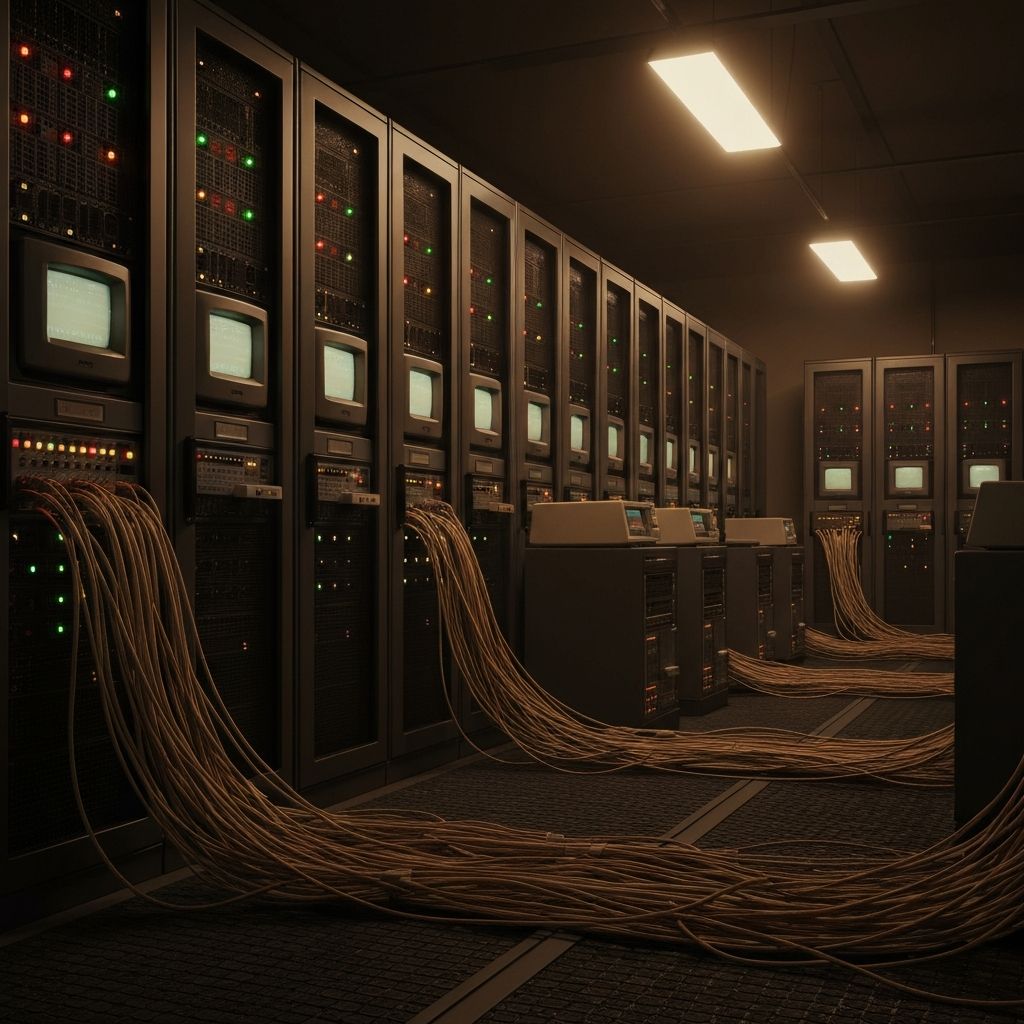
The Infrastructure Era
1960s -- 2000s"Have you tried turning it off and on again?"
IT's job was simple but brutal: keep the lights on. Servers, networks, mainframes -- value was measured in uptime, cost control, and "nothing broke today."

The Digital Era
2000s -- 2020sIT moved from cost centre to strategic weapon. Cloud, mobile, and SaaS turned technology into the front door for customers. Revenue per employee more than doubled.

The Cognitive Era
2023 -- PresentFor the first time in history, technology isn't just accelerating information -- it is augmenting cognition itself. AI is liberating enterprises from the constraints of cognitive labour.
The Compounding Effect of the Cognitive Power Law
Every previous technology wave transformed the speed and flow of information. But the human brain remained the bottleneck: every insight still needed a person to process; every judgement still needed a person to deliberate.
AI is fundamentally different. For the first time in human history, technology isn't just accelerating the movement of information -- it is augmenting cognition itself.
The steam engine liberated us from physical labour. AI is liberating enterprises from the constraints of cognitive labour: the analysis, pattern recognition, decision-making, and language that were once exclusively human territory.

The Cognitive Power Law -- Revenue per employee trajectory (2023 -- 2025)
NVIDIA: 3.5x Surge in the AI Era
Revenue per employee (fiscal year). Source: SEC filings via Bullfincher
$543K -> $3.6M in 9 years
Klarna
Revenue per employee nearly doubled to $1M. AI assistant handles two-thirds of all service chats -- equivalent of 853 agents. 96% of employees use AI daily.
Octopus Energy
AI handles over a third of all customer emails with 80% satisfaction -- surpassing 65% scored by trained human agents. Doubled in size annually.
Revolut
Grew to 52.5M customers with just 10K employees. Revenue per employee rose 43% then 38%. AI fraud detection prevented over €550M in scams.
NVIDIA
Revenue per employee surged from $543K (2016) to $3.6M (2025) -- building the infrastructure for the cognitive revolution.
"The numbers are compelling. But numbers alone won't shift how the board thinks. They need to feel the exponential -- not just see it in a chart. I need something that breaks their linear intuition..."
-- Alena, closing her laptop
Alena remembers an ancient legend -- the tale of a wise inventor who presented a chessboard to the king, asking for a single grain of rice on the first square, doubled on each subsequent one. The king laughed at such a modest request.
She decides: tomorrow, the board won't just hear about exponential growth. They'll experience it firsthand.
When cognitive tasks compound the way physical automation never could
The efficiency curve doesn't flatten. It steepens.
That compounding cognitive leverage is exactly what makes the idea of a "one-person IT" organisation suddenly feel plausible at enterprise scale.